Working for manufacturer engineering couple years. Sharing the manufacturing experience, skill, DFx, design, and information. Be care of this blog is personal share and content may not be 100% correctly.
What Is POC (Proof of Concept)? Its Role and Relationship with EVT, DVT, and PVT in New Product Development(This article discusses POC from the perspective of electronic hardware product development. Since Workingbear is not familiar with software development, POC practices in software projects will not be covered here.)
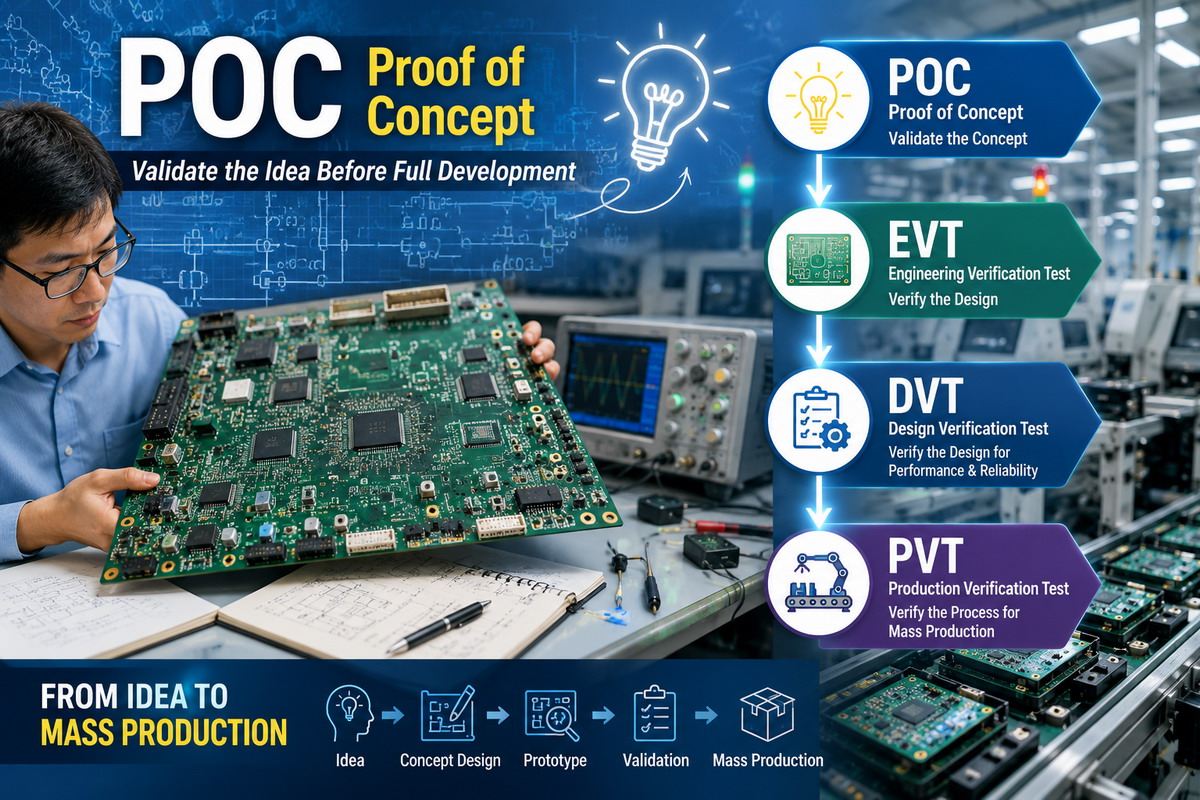
A new management team often brings new management methods. Recently, a new term, POC, started appearing in Workingbear’s new product development meetings. POC stands for Proof of Concept, which simply means verifying whether a concept or idea is technically feasible.
In simple terms, the main purpose of a POC is to validate whether engineers’ concepts, theories, or innovative ideas can actually be implemented. During new product development—especially for completely new or breakthrough products—it is essential to confirm that the core concept is feasible before the entire development team moves forward. Otherwise, a company may spend a significant amount of time and money completing a product design only to discover later that the idea cannot be manufactured or the technology does not work as expected.
So, POC sounds somewhat similar to the EVT stage that we are familiar with. In electronic product development, it is often similar to the concept of a “big board.” Before the design concept has fully matured, engineers may first complete the schematic design without worrying about the final PCB size. They create a large PCB that can accommodate all possible components, allowing the R&D team to verify their ideas, evaluate alternative circuit solutions, and debug the hardware design.
This type of oversized prototype board usually appears only in innovative products that require early hardware verification and debugging. It can be difficult to imagine that such a large and awkward circuit board may eventually evolve into a compact smartphone or a sleek consumer electronic product.
However, for projects involving a mature product revision, cost reduction, or a derivative design, whether a separate POC stage is necessary becomes debatable. These types of projects usually do not need to revalidate the original concept because the fundamental technology has already been proven. The main focus is often on modifying the appearance, adding or removing certain functions, or improving existing features. Therefore, the key verification work is typically related to PCB implementation, mechanical integration, and overall product optimization.
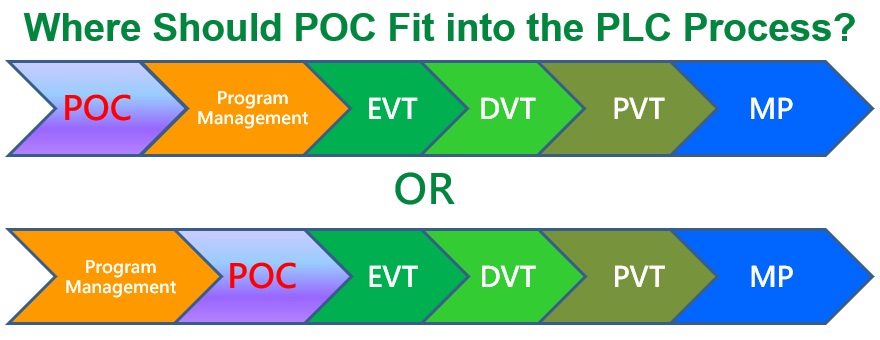
So the question becomes: Where should POC be placed within the Product Life Cycle (PLC) process? Is a POC stage always necessary?
Where Should POC Fit into the PLC Process?
PLC flow include POC
As mentioned earlier, for a completely new product, when the product concept has not yet been proven, the POC (Proof of Concept) stage should be placed at the very beginning of the project. If the concept fails to pass verification, the entire project may be terminated before it even reaches the later EVT, DVT, and PVT stages.
For mature product revisions, cost-down projects, or derivative products, companies often combine POC activities with EVT or even skip the POC stage entirely. This is because the product concept has already been validated in previous generations, and the remaining work is mainly to verify the new PCB design, mechanical structure, and product integration.
There is another viewpoint that places POC earlier in the hands of small development teams or talented makers. These individuals may be able to build their own prototypes using breadboards, simple PCB fabrication tools, and 3D-printed mechanical parts to validate their ideas before officially launching a product development project. This approach helps reduce early manufacturing costs, as production facilities often have minimum setup charges.
Once the concept has been proven and a formal PCB layout has been completed, an EMS (electronics manufacturing service) company or a PCBA manufacturer can then assist with prototype manufacturing, engineering builds, and later functional verification. Many makers have excellent ideas but may not have the manufacturing resources or experience required to turn those ideas into commercial products. In such cases, an EMS provider plays an important role in transforming an idea into a manufacturable product, and the POC may effectively occur before or alongside the formal project development process.
Workingbear’s Personal View
In Workingbear’s opinion, the exact position of POC within the product development process is not the most important issue. What really matters is understanding the purpose behind POC. A POC should act like a scouting or advance team before the main development force moves forward, identifying obstacles and reducing uncertainty before significant resources are committed.
The purpose of POC is to eliminate doubts about the core concept, transform an idea into a tangible prototype, and prove that the idea can realistically become a product.
(The opinions expressed in this article represent Workingbear’s personal understanding. Since Workingbear is not a project manager, different companies and industries may define or apply POC differently. If you have a different viewpoint or practical experience, feel free to share your thoughts and join the discussion.)







Leave a Reply