

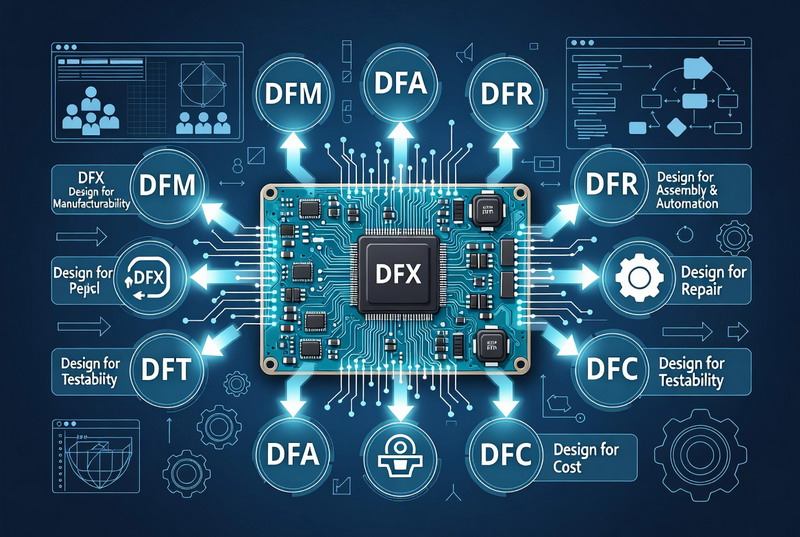
DFX is the general term for “Design for X.” It means considering all aspects of a product’s entire lifecycle right from the beginning of the design stage.
DFX originally stood for “Design for Excellence.” The word “Excellence” can be extended to many different areas, with the goal of making the product as outstanding and perfect as possible. Since perfection is almost endless, people started replacing “Excellence” with specific goals such as Manufacturability, Testability, Inspection, Repairability, Recycle, Cost, and so on — each representing an important aspect of the product’s lifecycle.
People from different departments usually bring their own design recommendations based on their experience. Manufacturing teams, in particular, tend to have the longest list of requirements. They want the product to deliver high quality, low cost, and easy production right from the start. It’s kind of like making a wish list for the “perfect partner” — tall, wealthy, attractive… but reality doesn’t always cooperate. So product designers actually have a pretty challenging job. From the very beginning, they’re expected to balance everyone’s expectations and requirements. In the end, product quality is largely determined during the design stage, and when a product succeeds, most of the credit usually goes to the RD team anyway. So there’s really no benefit in playing the blame game.
However, different departments often have conflicting DFX requirements. In these situations, the loudest voice usually comes from the production floor. Workingbear used to play exactly that role. For example, low cost often means lower quality or replacing expensive parts with hand soldering. A requirement that customers should not open the product usually means it’s almost impossible to repair. But Workingbear has also seen some really talented RD engineers who can navigate through all these conflicts, find a good balance, and still meet cost targets. Those people truly deserve a big thumbs up.
Additionally, as technology advances, some manufacturing processes that were impossible before may now be achievable. So we shouldn’t be stuck in our old ways. Everyone needs to keep looking for opportunities to improve. Pressure is what drives progress.
Different DFX requirements always come with trade-offs and the need for good communication. If something can’t be resolved, bring it up in the new product meeting to reach a consensus. If it still can’t be settled, escalate it to the project meeting and let the big bosses make the final call. Once the bosses decide, the little guys don’t have to carry the responsibility anymore (that’s how you survive in the system!).
Actually, before a new product even kicks off, management should clearly state what the priorities and expectations are for the product. Many requirements will inevitably require sacrificing something else. Making this clear early helps everyone work toward the same goal and successfully bring the product to life.

DFX can also be seen as the abbreviation for “Design for X,” where “X” represents the various important aspects of the product’s lifecycle.
- DFM: Design for Manufacturability
- DFA: Design for Assembly
- DFA: Design for Automation
- DFT: Design for Testability
- DFI: Design for Inspection
- DFR: Design for Repair
- DFC: Design for Cost
DFM: Design for Manufacturability
“Design for Manufacturability (DFM)” is also often called concurrent engineering or simultaneous engineering. Compared to the old way — where RD engineers would design and build prototypes all by themselves without input from manufacturing, then throw the design over the wall to the production line and wait for feedback — DFM offers major advantages such as shorter development time and lower development costs.
A typical DFM team usually includes RD engineers, Manufacturing engineers, Marketing representatives, Finance, Supply Chain, and other project stakeholders (sometimes even the customer). Because people from different areas are involved early, the team can consider manufacturability, assembly, inspection, repairability, recyclability, cost, and other factors from the very beginning — instead of fighting over changes after the design is already done. This helps speed up the project, reduces delays that commonly happen in traditional processes, and lowers the number of prototype runs and redesign costs.

Thanks to modern technology and powerful computing, many DFM checklists can now be checked automatically using CAD tools, especially for PCB and PCBA design. This greatly reduces human error and shortens review time. However, someone still needs to input and maintain the rules. These rules also need to be updated as technology improves. Some conditions still require human judgment based on severity. That’s why it’s best to categorize the rules into three levels: Must (must be fixed), Recommend (should be fixed), and Minor (can be left as is). This helps RD clearly understand which items are critical. It’s also very important to hold meetings with RD to explain why certain changes are needed and what we are trying to achieve. Many companies today also use dedicated DFM software (such as Valor, Allegro, etc.) to automate these checks.
In short, the core spirit of DFX is not to restrict RD, but to make the design competitive and manufacturable from the very start. Good DFM is not a battle between RD and Manufacturing — it’s a collaboration across departments to create real value together.
Related Posts:
- What Does NPI Stand For? Inside the Role That Brings New Products to Life
- How Pilot Production Helps Improve DFM, Process Stability, and Product Quality
- Exploring EVT/DVT/PVT: Explaining the Three Crucial Validation Stages in New Product Development
- Product Life Cycle (PLC) Explained: A Complete Guide to New Product Development in Electronics Manufacturing
Other Posts:




Leave a Reply