Working for manufacturer engineering couple years. Sharing the manufacturing experience, skill, DFx, design, and information. Be care of this blog is personal share and content may not be 100% correctly.
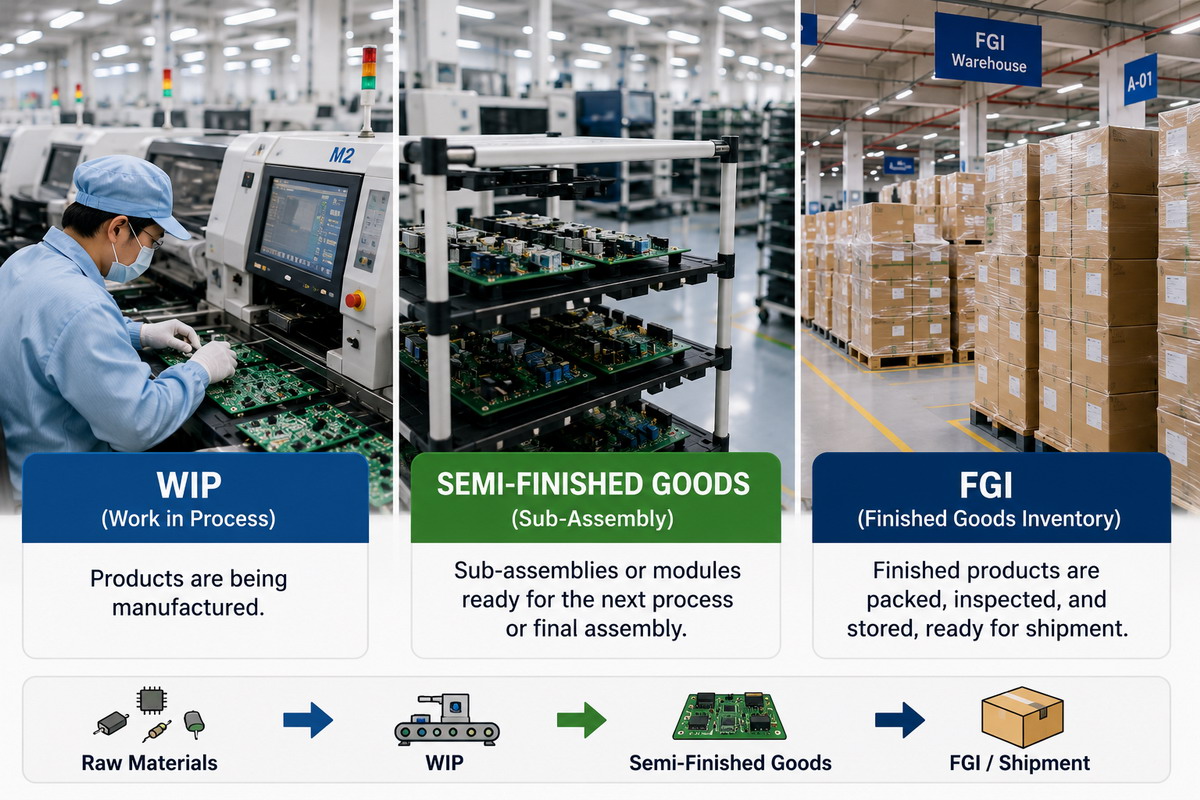
Filgure: What Are WIP (Work-in-Process), FGI (Finished Goods Inventory), and Semi-Finished Goods?
WIP stands for Work-in-Process (or Work-in-Progress), which refers to products that are currently going through the manufacturing process but have not yet been completed. In a broad sense, WIP can include semi-finished goods that have already completed certain manufacturing steps. In a narrower sense, however, WIP refers specifically to products that have not yet reached the semi-finished stage.
In many electronics manufacturing factories, a product can be considered WIP as soon as the kitting process begins. Once the product has completed all assembly operations, is packaged, passes OOB (Out-of-Box) or OQC (Outgoing Quality Control) inspections, and is officially transferred into finished goods inventory, it is classified as FGI (Finished Goods Inventory).
One reason manufacturers clearly distinguish WIP, semi-finished goods, and FGI is for inventory management and production control. By knowing exactly where products are in the manufacturing flow, managers can better monitor production status, control material movement, and estimate delivery schedules.
It also provides an important reference when implementing an ECO (Engineering Change Order). When engineers prepare an ECO, they must determine how to handle existing materials, WIP, and inventory, and estimate the cost and impact of applying the change.
A common misconception is that only FGI can be treated as inventory assets. In fact, under normal accounting principles, both WIP and FGI are considered inventory. However, some companies have historically used questionable practices, such as arranging premature shipments or moving products to off-site warehouses before actual customer delivery, in order to alter how inventory appears on financial statements. Such practices may fall into a gray area of financial manipulation and, in some cases, could result in misleading financial reporting.
Differences Between Finished Goods, Semi-Finished Goods, and WIP
Finished Goods (FGI, Finished Goods Inventory)
Finished goods refer to products that have completed all manufacturing processes within the factory, passed all required inspections, and have been officially received into the finished goods warehouse, making them ready for customer shipment.
If the product requires accessories, manuals, cables, or other included items according to the product specification or customer contract, all of these must be packaged together before the product can be classified as a finished good.
In simple terms, FGI represents the product exactly as the customer receives it, including its final packaging.
Semi-Finished Goods (Semi-Finished Products)
Semi-finished goods are products that have completed certain manufacturing or assembly operations, passed the required inspections, and either have been stored in a semi-finished goods warehouse or are ready to move to the next manufacturing process.
For example, a sub-assembly can be manufactured separately before final assembly. In the automotive industry, a car door assembly may have the window, handle, wiring, and electric mechanisms assembled and tested before it moves to the next production station or is stored as a semi-finished item.
Note: A Sub-Assembly is an intermediate module or unit created by pre-assembling multiple parts or materials into a specific functional component. It is not the final product itself but will later be integrated with other components during final assembly. Companies often use sub-assemblies because the same module may be shared among multiple products, or because the assembly process requires special fixtures, equipment, or highly skilled operators. Producing these modules on a dedicated production line improves consistency, reduces duplicated resources across multiple assembly lines, and increases overall manufacturing efficiency.
In addition, many semi-finished goods can be sold directly to customers as spare parts for repair and maintenance. This is especially true for components that require specialized equipment, fixtures, or manufacturing processes that customers cannot practically perform themselves. In such cases, selling a completed semi-finished assembly is much more practical than providing individual raw materials.
WIP (Work-in-Process)
WIP refers to products that are currently being processed at various manufacturing stages inside the factory. It may include items that are actively undergoing a manufacturing operation, products that have completed one process but are waiting for the next operation, or products that have finished manufacturing but have not yet been inspected and transferred into inventory.
Strictly speaking, WIP represents products in the transition stages between raw materials and semi-finished goods, as well as between semi-finished goods and finished goods. However, from a broader manufacturing perspective, WIP can also include semi-finished goods. In a narrower definition, WIP refers only to products that have not yet reached the semi-finished stage.







Leave a Reply