Working for manufacturer engineering couple years. Sharing the manufacturing experience, skill, DFx, design, and information. Be care of this blog is personal share and content may not be 100% correctly.
Figure:Product Life Cycle (PLC) Explained: A Complete Guide to New Product Development in Electronics Manufacturing
Product Life Cycle (PLC) is a framework used to manage a product throughout its entire journey—from the initial idea and market validation to development, production, continuous improvement, and eventually End of Life (EOL). While the exact process may vary from company to company, most follow a similar path to guide products from concept to market in a structured and controlled way.
In the electronics industry, PLC is more than just tracking whether a product grows or declines in sales. It helps companies make decisions, align cross-functional teams, manage risk, and balance time, cost, quality, and market expectations throughout development and production.
Some companies may use the term NPD (New Product Development) process instead. However, NPD is typically focused on creating and launching new products, while PLC covers a broader scope by including post-launch production support, cost optimization, sustaining activities, and eventual product retirement.
In the diagram above, the rectangular blocks represent the major stages of product development, while the diamond shapes indicate checkpoints (gates) used to determine whether a project is ready to move forward.
Not every product successfully reaches mass production. Some ideas are stopped early, while others are canceled halfway through development because market conditions change, competitors introduce better alternatives, or the business case no longer makes sense. Since developing a new product requires significant investment, each stage must be carefully evaluated to avoid wasting valuable time and resources.
Next, let’s briefly go through each stage of the Product Life Cycle.
Proposal (Idea Generation)
Almost every new product starts with an idea.
Some ideas come from market demand, some appear from an engineer’s sudden inspiration, and others may seem unrealistic—or even impossible at the time. But that does not mean they lack value. Many successful products were once considered impractical in their early days.
Because of this, good companies do not reject ideas too quickly. Instead, they create a mechanism to capture and organize ideas first, then evaluate them later to determine whether they deserve investment.
Today, many companies establish a structured Idea Management process. Common tools include:
Jira + Confluence: Suitable for engineering-driven organizations to manage and track product ideas through Issues, Epics, and structured workflows.
Aha! or Productboard: Designed specifically for product roadmap and product idea management, commonly used by mid-sized and large companies.
Internal innovation platforms: For example, systems built using Power Apps or integrated with Slack, Teams, WeCom, Lark, and similar collaboration tools to collect proposals.
These tools help companies gather ideas from sales, R&D, manufacturing, customer service, and even customers themselves, then support discussion, voting, scoring, and tracking.
It is also worth noting that new project opportunities do not always come from inside the company. Some products originate internally, but many projects are actually driven by customer requirements, market shifts, or major business opportunities.
In the Proposal stage, it is also recommended to establish a clear Kill Point, sometimes called Gate 0.
The purpose is not to reject creativity—it is to eliminate projects that are not worth pursuing as early as possible and avoid wasting limited resources.
Typical evaluation criteria include:
Market size is too small.
Low technical feasibility.
Expected gross margin does not meet targets.
Misalignment with company strategy.
Resource requirements are too high.
The earlier these decisions are made, the more resources can be focused on projects with real potential.
This is one of the common characteristics shared by highly efficient product development organizations: they do not necessarily do more projects—they stop weak projects earlier.
Speaking of this, it reminds people of the different strategies once adopted by Apple and hTC in the smartphone market: Apple focused on a Hero Product Strategy with the iPhone, while hTC expanded aggressively with a Product Proliferation Strategy. But that is another topic for another day.
Investigation (Market Research)
After a product concept passes the Proposal stage, the next question becomes: Does the market actually need this product?
Many products fail not because they cannot be built, but because they are built for customers who do not want them. Therefore, the purpose of the Investigation stage is to deeply understand the real needs of target users and potential customers instead of rushing into development.
Modern product development usually starts by creating an MRD (Market Requirements Document) to define market requirements, including target users, pain points, market size, competitive landscape, and price sensitivity.
Once the market needs are validated, they are translated into a PRD (Product Requirements Document), which converts customer needs into product specifications.
For electronic products, this may include requirements such as product appearance, display size and color, button design, communication interfaces, memory capacity, processor selection, power consumption, and cost targets.
Common approaches include Voice of Customer (VoC), Jobs-to-be-Done (JTBD), the Kano Model, and Conjoint Analysis to understand what customers truly value.
The most important goal of this stage is to validate both market demand and technical feasibility at the same time, preventing major investments in products that ultimately fail to meet market expectations.
Development (Research and Development)
This stage is what most people are familiar with as “R&D.” The engineering team should develop the new product based on the PRD created during the Investigation phase. At the same time, a more detailed ERS (Engineering Requirements Specification) should be generated to serve as the technical foundation shared across mechanical, hardware, firmware, software, packaging, documentation, certification, and related teams.
The development process is generally divided into three major stages: EVT (Engineering Verification Test), DVT (Design Verification Test), and PVT (Production Verification Test).
Product certification activities (such as CE, FCC, UL, etc.) should also be carried out in parallel.
Additional considerations during Development:
DFM / DFA / DFX implementation: Manufacturability should be considered as early as possible. DFM (Design for Manufacturing), DFA (Design for Assembly), and DFX (Design for Excellence) help ensure products are easier to manufacture, assemble, test, and service, significantly reducing cost and yield issues after mass production begins.
Should Cost Analysis: Development teams should estimate a target cost throughout the design process and continuously monitor actual design cost to avoid creating products that are technically excellent but commercially uncompetitive.
DevOps / CI-CD for embedded systems: Modern embedded product development increasingly adopts agile practices through DevOps culture and CI/CD (Continuous Integration / Continuous Deployment). Automated testing, version control, and daily builds help hardware, firmware, and software teams identify problems earlier and accelerate iteration.
Beta Implement (Pilot Launch)
Well-established companies rarely move directly into full-scale production immediately after development is completed.
Unless there is exceptionally strong market confidence—such as with the iPhone—it is generally recommended to go through a Beta Implement stage first.
The core concept of this phase is launching an MVP (Minimum Viable Product): a simplified version that delivers the essential value while entering the market quickly for validation.
Common approaches include:
Selecting representative customers for pilot programs.
Creating a Landing Page combined with a Pre-order mechanism to collect real customer interest and validate demand before full launch.
This phase focuses on three goals:
Validate whether the market truly accepts the product.
Collect authentic customer feedback.
Identify issues not discovered during development.
Many companies skip this step because they assume a well-developed product will automatically become successful.
The result can be excessive inventory, products sitting in distribution channels with little demand, or an initial sales surge followed by customer dissatisfaction caused by unresolved quality issues.
A strong Beta Implement phase can significantly reduce market risk and inventory loss.
Production (Mass Production)
Before entering mass production, companies must first establish an accurate demand forecast and prepare sufficient manufacturing capacity and production equipment.
Key activities during this stage include:
NPI (New Product Introduction) and production handoff: The R&D team should perform a complete transfer to manufacturing to ensure DFM readiness has been fully validated and to avoid the risk of jumping directly from EVT/DVT into production.
Ramp-up management: Production volume should increase gradually—starting with small validation builds, then scaling up step by step while monitoring process stability, yield, and product quality.
Supply chain risk management: Especially in the post-pandemic and geopolitical environment, companies should establish multi-source supplier strategies, safety inventory levels, and second-source alternatives.
Typical risks include unstable lead times, price fluctuations, and component quality issues, all of which require proactive contingency planning.
The most important goals during mass production are stable quality and controlled cost. Any major issue during this phase may lead to large inventory losses or customer complaints.
Sustaining (Continuous Improvement)
As production continues, improving quality and manufacturing yield becomes a top priority. Yield improvement not only increases effective production capacity but also reduces waste and lowers operating cost. Process optimization and component standardization are also common approaches, often supported by SPC (Statistical Process Control) and DOE (Design of Experiments).
Product lifecycle management does not end after mass production—it enters the critical Sustaining phase. The primary objective is to maintain stable supply, continuously optimize cost, and respond to market and supply chain changes.
Key activities include:
Value Engineering / Cost Reduction programs: Conduct regular value analysis and reduce cost through design optimization, alternative materials, and process improvements.
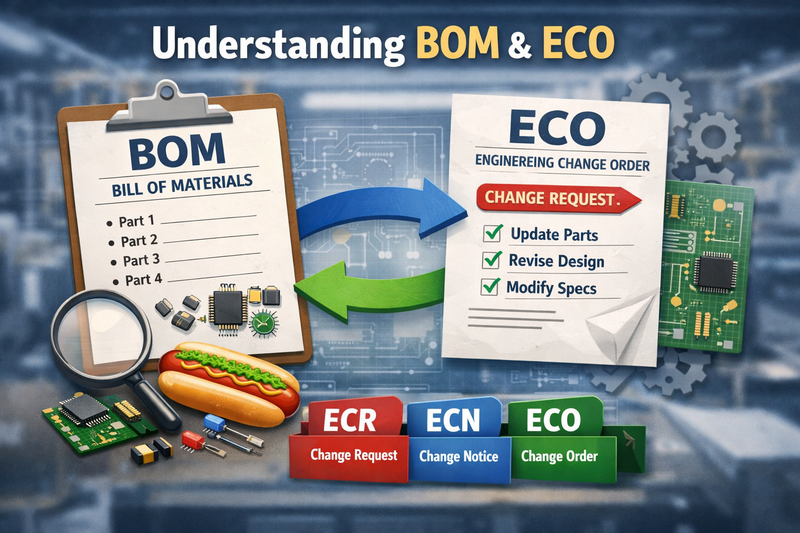
Product Change Notification (PCN) management: When suppliers change component specifications or engineering changes (ECO) are introduced internally, strict PCN procedures must ensure customer visibility and compatibility validation.
Obsolescence Management: Monitor component lifecycle status (EOL / End of Life) proactively and prepare Last Time Buy plans, alternative sourcing, or product redesign strategies to prevent production interruption.
SPC and DOE methodologies are commonly used during this phase, requiring close collaboration among engineering, manufacturing, sourcing, and quality teams.
Strong sustaining capability is often one of the key factors behind long-term product profitability.
EOL (End of Life)
When product sales decline, profit margins shrink, technology becomes outdated, or key components become unavailable, the product enters the End of Life (EOL) stage.
This is the final phase of the product lifecycle, and proper execution helps minimize losses while protecting company reputation.
Major activities during EOL include:
Create an EOL plan: Define the last production date and last shipment date, and notify customers 6–12 months in advance.
Last Time Buy (LTB): Provide customers with a final purchasing opportunity so they can build sufficient inventory.
Inventory and component disposition: Manage remaining finished goods inventory and consume long-lead purchased materials to prevent excess stock.
Replacement strategy: Introduce next-generation products and support customer migration.
Documentation and technical support: Preserve drawings, firmware, test programs, and service documentation while defining support duration.
Environmental and recycling compliance: Ensure compliance with regulations such as WEEE and RoHS and manage recycling responsibilities.
One of the biggest mistakes during EOL is stopping supply unexpectedly and causing customer disruption. Excellent companies treat EOL as an important customer service opportunity and use it to strengthen long-term relationships.
Check Point
Each stage of product development typically includes a Check Point used to determine whether the project is ready to move forward.
These checkpoints are usually supported by a checklist and evaluation criteria and are reviewed by a committee made up of senior management and cross-functional leaders.
P/I: Proposal to Investigation
I/D: Investigation to Development
DR: Design Release
SR: System Release
MR: Manufacturing Release
EOL: End of Life Release
Conclusion
Product Life Cycle serves as an important framework for new product development in the electronics industry. Managing the complete process—from Proposal through EOL—helps companies allocate resources systematically, reduce risk, and maximize product profitability.
Traditional Stage-Gate processes emphasize phase reviews and formal gate decisions, making them suitable for complex electronic products with strict internal controls. Lean Product Development focuses on eliminating waste and accelerating learning. Agile development emphasizes flexibility and iteration, making it suitable for software and rapidly changing consumer products.
Today, many companies adopt a hybrid Stage-Gate + Agile model: using Stage-Gate to maintain strategic control early in development and Agile practices later to accelerate execution.
As technology advances, PLC continues to evolve:
AI-assisted development: Accelerates requirement analysis, automates design verification, and generates test cases to shorten development cycles.
Digital Twin: Simulates product performance and manufacturing processes in virtual environments to reduce physical prototypes.
Agile within PLC: Enables cross-functional teams to develop, validate, and adjust simultaneously in response to changing market conditions.
Regardless of methodology, successful PLC management always comes back to the same principles:
Validate early.
Learn quickly.
Be willing to stop projects that no longer make sense.
In today’s highly competitive electronics industry, continuous improvement of product lifecycle management remains essential to increasing product success rates and sustaining long-term competitive advantage.









Leave a Reply