Working for manufacturer engineering couple years. Sharing the manufacturing experience, skill, DFx, design, and information. Be care of this blog is personal share and content may not be 100% correctly.
Caption: The FPC is inserted into a connector on the PCB.
At a basic level, FPCs and PCBs are very similar in both function and structure. Whether it’s an FPC or a PCB, both use copper traces on the surface—and sometimes inside the board—to carry electrical signals.
The biggest difference between them lies in the base material.
A traditional PCB uses a glass-fiber–based substrate, which makes the board hard and rigid. An FPC, on the other hand, is mainly made from polyimide (PI) or Polyester (PET). You can think of it as something closer to thick paper: flat, thin, flexible, and bendable.
FPC, FPCB, Flex-PCB — what’s the difference?
FPCB is short for Flexible Printed Circuit Board and is sometimes simply called FPC. In this article, Workingbear will use FPC for simplicity.
Strictly speaking, PCB is a general term that covers all printed circuit boards. Under that umbrella, there are three main types:
Rigid PCB
Flexible PCB (FPC)
Rigid-flex PCB
In everyday conversations, when people say “PCB,” they are usually referring to a rigid PCB.
Why use an FPC?
FPCs are thin, lightweight, flexible, and easy to bend, and these features are exactly what make them valuable.
They are especially useful in products where:
Internal space is very limited
A single rigid PCB cannot meet all design requirements
Multiple PCBs must be stacked or connected in tight spaces
In many designs, FPCs are used to:
Connect multiple PCBs layered on top of each other
Bridge long distances between separate boards while saving board area
Connect PCBs that are positioned vertically or at different angles
Why FPCs are not ideal for complex circuits or heavy component assembly
In general, FPCs are not well-suited for very complex routing or for mounting many precision components, for several reasons:
Solder joint cracking Because an FPC bends easily, solder joints on mounted components are more likely to crack when the board flexes.
Lower heat resistance than rigid PCBs Compared to rigid PCBs, FPCs are more sensitive to high temperatures. Under heat, they are more prone to warping or delamination.
Lower solder mask accuracy FPC solder masks are typically made from PI film. You can imagine this film as something similar to a thin plastic sheet. The pad openings in PI film are usually created by die punching, then laminated onto the FPC. This process is less precise than the screen printing or photo-imaging methods used on rigid PCBs. As a result, pad openings are more likely to be misaligned or uneven.
Not suitable for many copper layers As more copper layers are added, an FPC becomes stiffer and loses its flexibility—essentially defeating its main advantage. In addition, creating accurate pad openings for multi-layer FPCs often requires laser processing, which significantly increases cost.
So how do some FPCs carry precision components?
You might still see FPCs with fine-pitch or precision components—for example, inside digital cameras. How is that possible?
The solution is actually quite simple.
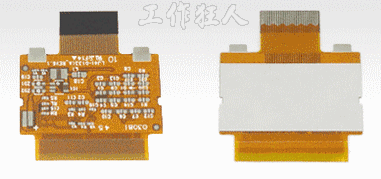
A rigid stiffener is bonded to the back side of the FPC in areas where precision components need to be soldered. This stiffener provides mechanical support and prevents flexing during assembly and use.
However, there are trade-offs:
Components can only be mounted on one side in the stiffened area
The stiffener itself has no circuitry—it is purely structural
The cost of this type of FPC is much higher than a standard FPC
In some cases, it can even be more expensive than a rigid PCB
From Workingbear’s perspective, FPCs are powerful tools when used correctly, but they are not a universal replacement for rigid PCBs. Understanding their strengths and limitations early in the design phase can save a lot of cost, rework, and headaches later on.








Leave a Reply