Working for manufacturer engineering couple years. Sharing the manufacturing experience, skill, DFx, design, and information. Be care of this blog is personal share and content may not be 100% correctly.
As electronics keep getting smaller and more advanced, the need to connect flexible printed circuits (FPCs) to rigid PCBs continues to grow. In this article, Workingbear will walk you through the most common methods used in the industry today—and share some practical insights from real-world experience.
Why FPCs Are Widely Used
FPCs (Flexible Printed Circuits) are used in a wide range of products, especially:
Wearable devices
Compact handheld electronics
They’re great for saving space and allowing flexible routing.
Yes, modern processes do allow components to be mounted directly on FPCs—but in my experience, the solderability and long-term reliability are still not ideal.
For example, I generally don’t recommend placing the following components directly on FPCs:
User-facing I/O connectors (like Micro-USB or USB-C)
Large packages such as BGAs or QFNs
So How Do We Connect FPC to PCB?
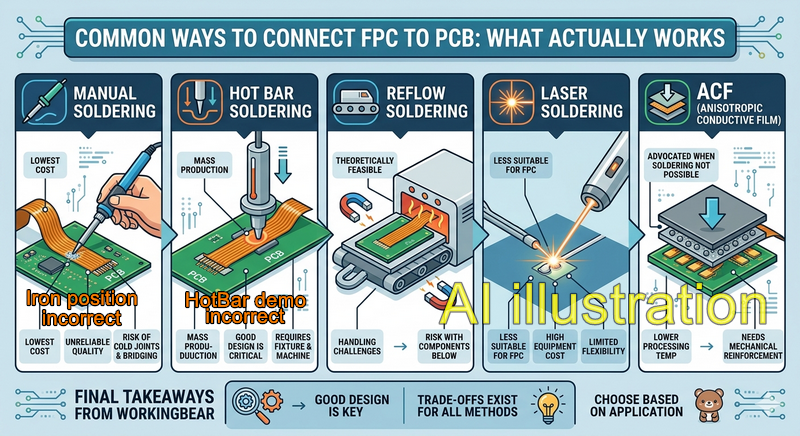
In most cases, FPCs still need to be connected to a rigid PCB. Common approaches include:
In this article, I’ll focus specifically on soldering methods.
1. Manual Soldering (Soldering Iron)
This is the lowest-cost solution—and sometimes you don’t even need a fixture.
But it comes with a price: unreliable quality.
Common issues include:
Cold joints
Open joints
Weak (intermittent) solder joints
Solder bridging
Why does this happen?
Because during manual soldering, the FPC can easily move or lift slightly before the solder solidifies. Once the solder cools, defects are already locked in.
Practical tip from Workingbear:
I do recommend placing a weight on the FPC during soldering and keep it in place until the solder fully solidifies. This simple trick can significantly improve yield.
Also, if possible:
👉 Add plated through holes (PTHs) at the FPC gold fingers
This helps:
Provide visual confirmation of solder quality
Reduce the risk of solder bridging
When should you use manual soldering?
Early design stage (before design lock)
Small quantities for functional verification
👉 For mass production: I strongly recommend avoiding manual soldering.
2. Hot Bar Soldering
Hot Bar soldering uses pulse current passing through high-resistance materials (like molybdenum or titanium) to generate heat (Joule heating).
This heat is transferred through a thermode (heater tip) to:
Melt pre-printed solder paste on the PCB
Bond the FPC to the PCB
Requirements:
A Hot Bar machine
A fixture (carrier) to hold the FPC in place
If both the design and setup are done properly, this method can achieve stable mass production with decent yield.
What affects quality the most?
👉 Design
From my experience, most Hot Bar issues trace back to poor design, not the machine itself.
Key factors include:
Pad design
Trace layout
Heat transfer efficiency
Another growing challenge
As products get smaller, FPC pitch keeps shrinking.
Smaller pitch → harder to process
Lower yield
This is becoming a real headache in production.
Process control also matters:
Solder paste volume
Flux application
Temperature / pressure / time settings
Machine capability (e.g., programmable pressure)
Special case: poor heat transfer
Some FPC designs don’t transfer heat efficiently. In those cases, you might consider:
👉 Low-temperature solder paste (SnBi or SnBiAg)
But keep in mind:
SnBi and SnBiAg solder is more brittle
Additional mechanical support may be needed
3. Reflow Soldering
I personally haven’t run this process myself, but it is theoretically feasible—and I’ve seen it discussed in forums.
Basic idea:
Print solder paste on PCB
Place the FPC onto the PCB
Use a reflow carrier (top + bottom fixture)
Run through a reflow oven
Magnets are often used in the carrier to:
Hold the FPC in place
Prevent lifting during reflow
Key concerns:
1. Temperature resistance
Can the FPC material survive lead-free reflow temperatures?
If not, you may need to consider low-temperature solder paste.
2. Handling challenges
FPC placement is usually manual, while solder paste is still wet.
👉 Avoiding accidental contact with paste or nearby components is difficult.
Because of this:
Not suitable for designs with components under the FPC
High risk of defects in complex assemblies
Workingbear’s take:
This method works best when:
The PCB has minimal components
The FPC itself has no mounted parts
👉 Fine-pitch FPCs are generally not a good fit for this process.
4. Laser Soldering
Laser soldering uses laser energy converted into heat to melt solder at specific locations. In theory, it sounds great. But in practice, I don’t find it very suitable for FPC-to-PCB soldering.
Why?
Many FPC designs do not have through holes, which means:
👉 The laser cannot directly heat the solder joint effectively
Additional drawbacks:
Equipment is typically dedicated (not versatile)
High cost
Limited flexibility for other processes
Unless you have very high production volume, I’d suggest:
👉 Run the ROI calculation carefully before investing
Personally, I think laser soldering is better suited for connector soldering.
5. ACF (Anisotropic Conductive Film)
When soldering is not an option, ACF can be a good alternative.
ACF is essentially a conductive adhesive placed between:
FPC gold fingers
PCB pads
Then bonded using heat and pressure.
Advantages:
Lower processing temperature than Hot Bar
Reduced risk of thermal damage to FPC
Process is relatively simple
Some machines can even support both Hot Bar and ACF processes with adjustable settings.
The biggest drawback:
👉 Long-term reliability
Over time, the adhesive can degrade or delaminate.
So in most cases, you’ll need:
👉 Additional mechanical reinforcement
to prevent the FPC from detaching from the PCB.
Final Thoughts
There’s no one-size-fits-all solution for FPC-to-PCB connection.
Each method has its own trade-offs:
Cost vs. reliability
Flexibility vs. durability
Process simplicity vs. yield
From Workingbear’s experience:
👉 Good design is far more important than the process itself
If the design is right, most processes can work. If the design is flawed, even the best process will struggle.
Have you tried any of these methods in your projects?
Workingbear would love to hear your experience—and what worked (or didn’t).


 Hot Bar soldering uses pulse current passing through high-resistance materials (like molybdenum or titanium) to generate heat (Joule heating).


Leave a Reply