


Flexible printed circuits (FPCs) are widely used because they can bend and fold. They’re perfect for compact products or for connecting signals between different PCBAs. But there’s a downside. As usage increases—especially in applications with repeated motion—FPCs can develop open circuits or intermittent connections over time.
The Strange Case: Open Circuit with No Visible Damage

When we suspect an FPC has an open circuit, the most straightforward approach is to inspect the traces under a microscope. Since most FPCs are single-layer (or at most three layers), the copper traces are usually visible with optical tools.
But Workingbear has run into this situation more than once:
- No visible cracks under the microscope
- But a multimeter shows an open circuit at the gold fingers
- Or worse—intermittent contact
Frustrating, right?
Why This Happens
There’s really no need to be surprised. FPCs are called “flexible” for a reason—they’re designed to bend. That flexibility is both their biggest strength and their biggest weakness.
Even though copper foil is relatively ductile, repeated bending, flexing, or mechanical stress can still cause:
- Trace fractures
- Solder joint cracking
If the crack is visible, the problem is usually easier to solve. You can locate the failure point, understand the root cause, and take corrective action.
The real challenge is when:
👉 You can measure an open circuit, but you can’t find where the trace is broken.
And without knowing the exact location, it’s very difficult to determine the true cause.
Workingbear’s Approach: Section-by-Section Isolation
When dealing with these “invisible” failures, I typically use a step-by-step isolation method.
Step 1: Look for suspicious areas
Start by inspecting the trace under a microscope. If you find any suspicious spots, mark them.
Step 2: Divide the trace into sections
If nothing stands out, mentally divide the trace into smaller segments to narrow down the search.
Step 3: Expose the copper trace
At suspected locations—or at segment boundaries—carefully remove the outer cover film.
Here’s how I usually do it:
- Use a sharp blade (a new utility knife or precision knife works best)
- Gently scrape the cover film back and forth
- Slowly expose the copper trace underneath
Once exposed, you can probe the trace directly with a multimeter. By checking segment by segment, you can gradually eliminate possibilities and pinpoint the exact break location.
Step 4: Alternative method (lower risk)
If you’re worried about accidentally cutting the trace, try this instead:
- Cut into an area next to the trace (where there is no copper)
- Carefully peel back the cover film
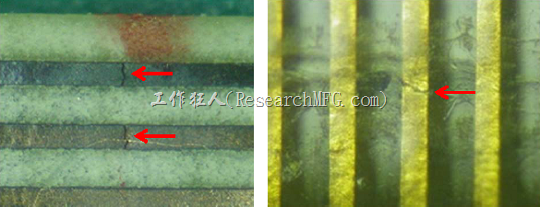
This achieves the same goal while reducing the risk of damaging the trace.
(That said, this method still requires a steady hand and a lot of patience—but I believe any skilled engineer can handle it.)
Step 5: Reveal the hidden crack
Once you’ve identified the exact location of the break, you might still not see any visible damage.
In that case:
👉 Gently bend the FPC at that location while observing under a microscope
This usually helps “open up” the crack, making it visible.
Final Reminder
One last thing to keep in mind:
👉 This method is considered semi-destructive.
So always perform all non-destructive inspections first before cutting into the FPC cover film.
Have you ever dealt with this kind of hidden FPC failure?
Workingbear would be interested to hear how you approached it.
Related Posts:
- Root Cause Analysis: Why FPC Traces Break
- What Is an FPC (Flexible Printed Circuit Board)?
- How I Troubleshoot Hidden Open Circuits in FPCs
- Design Guideline for Flex cable(FPC) Trace Pattern
- The Difference Between ED Copper and RA Copper in FPC
- FPC Structures — Single-Sided and Double Access Designs
- Common Ways to Connect FPC to PCB: What Actually Works
- How to Design FPC-to-PCB Connections for Better Assembly (DFx)
- Why RA Copper Is Preferred Over ED Copper for FPC Applications?


Leave a Reply