Working for manufacturer engineering couple years. Sharing the manufacturing experience, skill, DFx, design, and information. Be care of this blog is personal share and content may not be 100% correctly.
Recently, my company started seeing an increase in field returns caused by open circuits in flexible printed circuits (FPCs) inside the terminal. After digging into several cases, the root cause turned out to be broken copper traces. So what’s going on?
The Trade-Off: Flexibility vs. Durability
A few years ago, we transitioned from 1/2 oz copper to thinner 1/3 oz copper. At the same time, many of our designs evolved from single-layer FPCs to double-layer or even multi-layer structures.
This shift made sense. Thinner copper improves flexibility—especially for applications involving static bending—while also helping reduce overall thickness and weight.
But there’s a trade-off.
Thinner copper inherently has lower resistance to repeated flexing. Even though we use rolled annealed (RA) copper, which offers better ductility than electrodeposited (ED) copper, trace failures can still occur under certain conditions.
In theory, RA copper should perform well as long as the bend is gradual and not too sharp. In reality, however, failures can still happen when factors like these come into play:
Poor adhesion between copper and polyimide (PI)
Localized stress concentration
Copper thickness approaching its mechanical limits
When the failed units came back, the first step was straightforward—we confirmed open circuits using a multimeter.
But locating the exact failure point was surprisingly difficult.
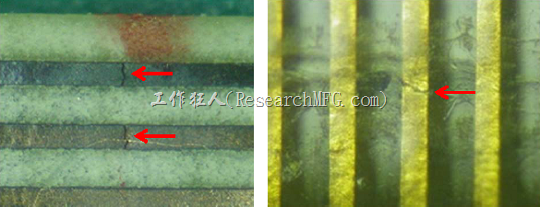
Even under a microscope, the traces appeared intact.
The supplier eventually identified the issue using a simple but effective method:
Gently flex the FPC (without sharp folding)
Inspect the circuit inch by inch under magnification
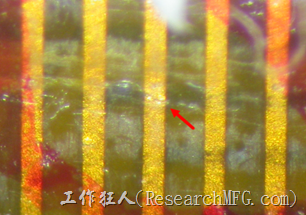
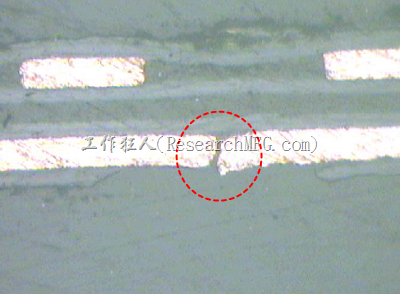
Only when the FPC was under slight bending stress did the cracks become visible.
👉 In other words, the traces were already fractured—but when the FPC was flat, the cracks were nearly impossible to see.
When Did the Damage Occur?
Interestingly, the failure locations did not align with typical high-risk areas:
No sharp bends
No visible damage during assembly
This strongly suggests the issue was not process damage during assembly, but rather:
👉 A latent defect introduced during material preparation or lamination
The defect remained hidden until the product experienced stress over time in the field.
Supplier’s Root Cause Explanation
After several weeks of investigation, the supplier concluded:
The failure was caused by micro-gaps between the copper trace and the PI layer, which reduced mechanical support. Over time, repeated stress led to cracking.
This is a reasonable explanation.
Such gaps can result from:
Lamination process variations (e.g., vacuum press vs. quick press)
Incomplete air removal
Insufficient surface treatment before bonding
But Is That the Whole Story?
From Workingbear’s perspective, the explanation is only part of the picture.
If the issue were caused by something fundamental—like using the wrong type of copper (for example, ED instead of RA)—we would expect widespread, systematic failures.
But that’s not what we’re seeing.
Instead, the failures are:
Random
Isolated
Difficult to reproduce
This points to a more realistic scenario:
👉 A combination of localized process variation and unavoidable micro-scale defects
And frankly, completely eliminating these micro-gaps in real-world manufacturing is extremely challenging.
Design and Process Recommendations
Based on this experience, here are a few practical suggestions:
1. Keep traces near the neutral axis
In multi-layer FPC designs, placing traces closer to the neutral axis helps minimize tensile and compressive stress during bending.
2. Avoid stacking stress points
In bending areas, avoid aligning multiple material transitions at the same location. This includes:
Copper traces
Coverlay (CVL)
Stiffeners
👉 Stagger these features to reduce stress concentration.
3. Use an appropriate bend radius
When working with thinner copper:
Increase the bend radius, or
Use higher-grade RA copper
4. Strengthen lamination quality control
Consider adding:
Microscopic inspection
Controlled bending or flex testing
👉 These methods can help identify hidden defects before shipment.
Final Thoughts
FPC failures like this are particularly challenging because:
They can pass initial inspections
They may not appear until long after deployment
And they are extremely difficult to detect visually
Have you encountered similar FPC reliability issues in your projects?
Workingbear would love to hear your experience—and how you solved it.





Leave a Reply