Working for manufacturer engineering couple years. Sharing the manufacturing experience, skill, DFx, design, and information. Be care of this blog is personal share and content may not be 100% correctly.
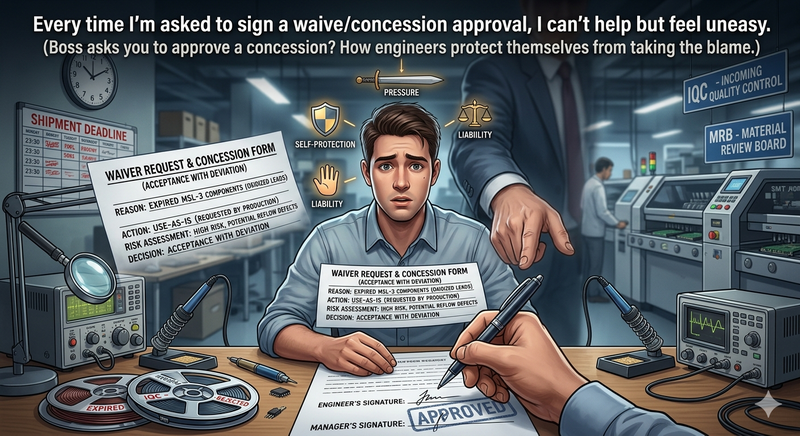
Caption: Every time I’m asked to sign a waive/concession approval, I can’t help but feel uneasy. (Boss asks you to approve a concession? How engineers protect themselves from taking the blame.)
Have you ever been in this situation? It’s late at night, you’re working overtime, and suddenly your manager drops a pile of expired components or badly out-of-spec parts on your desk and says, “The customer needs this shipped urgently—just sign a waiver and go home!” Have you ever faced that moment? And after you sign the waiver, if something goes wrong, who actually takes the blame?
Workingbear remembers when he first entered the electronics industry as a junior product or process engineer. The first time colleagues from Quality and Production asked him to “waive” a product, He just froze on the spot. He had no idea what they were talking about—and even got laughed at by the line supervisor.
Later, he looked the word up in an English dictionary, but things were still unclear. Literally, “waive” can mean “to exempt,” “to give up,” “to withdraw,” “to set aside,” or “to postpone.” But that still didn’t explain what “waive” really meant inside a factory. He asked several senior colleagues, but no one could explain it clearly either. All he knew was that, in electronics manufacturing, “waiver” means allowing a product or material to be used even though it does not fully meet the original specification.
So back then, all Workingbear really understood was this: when incoming parts or finished products were found not to meet drawing specifications, and the factory was under pressure to keep production or shipments on schedule, engineers would be forced by the PC department or line managers—sometimes feeling like there was a knife at their neck (under heavy pressure)—to release the material to the production line as quickly as possible. Reluctantly, the engineer would walk to IQC (Incoming Quality Control) or the production line and sign a “waiver letter,” essentially a contract that allowed out-of-spec parts to be used on the line or slightly defective (but supposedly non-critical) products to be shipped to customers.
Note: In most mid- to large-sized manufacturing plants, waivers typically go through an MRB (Material Review Board) meeting. This meeting usually brings together representatives from Distribution, Production Control, Quality Assurance, Production, Testing Engineering, and Product or Process Engineering to decide whether to approve the waiver. In theory, it is a collective decision, with shared responsibility among all participants. In reality, however, most of the pressure often falls on the engineer to ultimately sign off on the waiver. For more details, see the article “MRB Decision-Making and Cosmetic Quality Evaluation for Plastic Parts.”
Where Did “Waiver Letters” Come From?
After spending more time working in factories, Workingbear gradually realized that “waive” in English actually means giving up one’s own rights. According to procedure, IQC must ensure that parts meet specifications before releasing them. If IQC privately releases problematic parts into inventory or onto the line, and a quality issue later occurs, the process engineer has every right to hold IQC accountable. However, once Workingbear signs a waiver letter, it means he has given up that right and can no longer demand responsibility from IQC. (Why would anyone willingly give up their own rights? Because they’re being forced to.)
Workingbear once found information suggesting that waiver letters originated in Europe. In the past, nobles owned large areas of land and forests. If a hunter wanted to hunt on private land, they had to obtain a signed waiver letter from the landowner. Once the hunter had this waiver, they could hunt there for free, and the landowner would not be held liable for any accidents. Later, Workingbear tried to verify this story again but couldn’t find reliable sources. So treat it as an unverified anecdote – for entertainment only. Today, waiver letters are widely used in business and engineering, such as allowing one company to use another company’s patent for free, or approving the use of out-of-spec components in manufacturing.
The Role of IQC in Electronics Manufacturing
From Workingbear’s experience, most electronics assembly factories have an IQC (Incoming Quality Control) department. All components must pass IQC inspection before being released to the warehouse or production line. A single finished product often contains hundreds of different parts. If even one part has a problem, it can affect assembly, shipment schedules, and overall product quality. If products can’t be shipped on time, the company can’t make money—so the losses can be significant.
ISO Terminology: Not “Waive,” but “Concession” and “Deviation Permit”
When Workingbear later reviewed ISO and quality system documents, he discovered something important:
ISO standards do not use the terms waive or waiver letter.
Instead, they use:
Concession – acceptance with deviation
Deviation permit – formal approval to deviate from specification
For automotive electronics under IATF 16949, a concession must be approved in writing by the customer. Otherwise, the supplier bears full responsibility.
Always confirm whether the customer requires a formal Deviation Request or Concession Form.
Engineer Self-Protection Rules When Signing a Waiver
As a product or process engineer, you need to have some backbone. You shouldn’t give in just because someone pressures you. Even if you must sign a waiver letter, you should only do so after verifying that quality and functionality are acceptable. Otherwise, when problems show up later, you’ll be the one cleaning up the mess.
The most common issue with electronic components is expired shelf life. Before approving a waiver, you should confirm the following points:
Check for oxidation on component leads, because oxidation affects solderability. Perform solderability tests by sampling parts and testing them in a solder pot, with a soldering iron, or using a solder balance. Only approve parts that can properly wet with solder. Note that soldering irons usually run at higher temperatures, so lightly oxidized parts may still solder. The best test is one that closely simulates actual production conditions.
If solderability is acceptable, the parts should still be baked according to J-STD-033 requirements for MSL components before going into production. This helps prevent moisture-related defects during reflow soldering.
When production starts, run a small pilot lot first. Once everything is confirmed to be stable, then move to mass production. This reduces risk if issues were missed earlier.
For mechanical parts, the most common problems are cosmetic defects and out-of-spec dimensions. Cosmetic issues are subjective, as they depend on personal judgment, and some defects may not even be visible to all users.
It’s recommended to review cosmetic acceptability together with the quality engineer, since final cosmetic acceptance is judged by the customer, and Quality is the one facing the customer.
For cosmetic standards, refer to the article: How to Define Cosmetic Acceptance Criteria for Plastic Parts.
For dimensional issues, extra caution is required because dimensions directly affect product functionality. In general, waiving critical dimensions is not recommended. For other dimensions, consider the following:
Assemble the part with its mating components and perform functional tests.
If you lack experience, ask a more experienced engineer to help. Sometimes functional issues don’t appear on the out-of-spec part itself but show up in related components. These issues require deep product knowledge to identify.
After approval, waived parts must be tracked closely. Monitor the production line for abnormal defects and record the serial numbers, dates, quantities, and lot numbers of products built using waived parts for future traceability.
For any waived parts or products, proper documentation is essential. Never approve a waiver verbally. The documentation should clearly record which serial numbers and part numbers used waived components. If possible, include photos, test data, and risk assessment reports. This helps Quality investigate issues later, ensures shared responsibility through cross-department sign-off, and makes waiver decisions transparent and standardized, avoiding any suspicion of under-the-table approvals. Workingbear’s company later fully digitized this process, managing all documents and ECOs through a PLM system, including waiver records, which made management, searching, and approvals much easier.
Finally, Workingbear wants to emphasize one key point: waiver, concession, deviation permit should never become normal practice. It should be a temporary, last-resort solution. If a waiver becomes routine, the real solution is a design change—either modifying the design itself or relaxing specifications in a controlled way. Waivers must be clearly verified, fully documented, and properly authorized. This protects the company—and it protects you. When facing unreasonable demands, engineers should feel confident saying “No” or requesting an MRB decision, instead of carrying all the pressure alone.
If you’ve had similar experiences, feel free to leave a comment and share your waiver stories or self-protection tips!










Leave a Reply